Introduction: The Right Round Baler Starts With Your Farm
Buying an agricultural round baler is not simply a matter of choosing the machine with the highest capacity or the largest bale chamber. A baler that performs exceptionally well on dry alfalfa may not be the best choice for wet silage, dense corn stalks, or abrasive crop residues. Likewise, a machine designed for a large commercial contractor may create unnecessary cost and complexity for a smaller livestock farm.
The most important buying decisions usually involve crop type, tractor compatibility, bale dimensions, chamber design, pickup configuration, wrapping method, field conditions, maintenance requirements, and the way the finished bales will be stored or sold.
The University of Georgia’s round-baler selection guidance similarly emphasizes matching the baler to available tractor horsepower, desired bale size, and wrapping requirements rather than treating all round balers as interchangeable.
This 2026 guide walks through those decisions in a practical sequence so you can compare machines according to the work they actually need to perform.
By the end, you should be able to:
- ✓ Match a baler to your primary crop
- ✓ Check tractor and PTO compatibility
- ✓ Compare fixed and variable chamber designs
- ✓ Select an appropriate pickup and bale size
- ✓ Decide between net, film, and other wrapping options
- ✓ Evaluate automation without paying for unnecessary technology
- ✓ Compare machines using total operating value rather than specifications alone
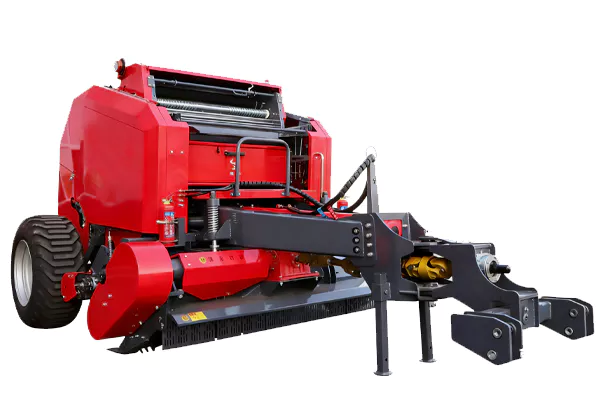
Alt Text: Agricultural round baler machine showing pickup and bale chamber design
Table of Contents
- What Is an Agricultural Round Baler?
- Start With Crop Type and End Use
- Fixed Chamber vs Variable Chamber
- Match the Baler to Your Tractor
- Choose Pickup Width and Feeding System
- Select Bale Size and Density
- Net Wrap, Twine, or Film?
- Automation and Sensors in 2026
- Compare Field Conditions and Maintenance
- Round Baler Selection Matrix
- Common Buying Mistakes
- Key Takeaways
- Frequently Asked Questions
What Is an Agricultural Round Baler?
An agricultural round baler is a PTO-driven or tractor-powered harvesting machine that collects windrowed forage or crop residue, feeds the material into a bale-forming chamber, compresses it into a cylindrical bale, secures the bale with net, twine, film, or another wrapping material, and ejects it for handling and storage.
Unlike a square baler, the machine continuously rolls incoming crop material inside a circular chamber. The precise formation method varies by machine. Depending on the design, belts, rollers, chains, or combinations of these components may control rotation and compression.
Round bales are widely used for hay, alfalfa, pasture grass, straw, silage and crop residues. However, crop suitability depends on the individual baler design. A buyer should never assume that a machine optimized for dry hay can automatically handle wet or fibrous material.
Quick Glossary
| Term | Meaning | Why It Matters |
|---|---|---|
| PTO | Power Take-Off | Transfers tractor power to the baler |
| Pickup | Mechanism collecting crop from the windrow | Influences feeding and field capacity |
| Bale Chamber | Area where the bale forms | Determines bale formation and density |
| Bale Density | Amount of crop compressed into bale volume | Affects handling, transport and storage |
| Net Wrap | Mesh material wrapped around the bale | Secures bale quickly after formation |
| Baleage | High-moisture forage preserved by fermentation | Requires appropriate baling and wrapping |
For a current overview of available machine configurations, see the Agricultural Round Baler range.
1. Start With Crop Type and End Use
The first question should not be, “How many bales per hour can this machine produce?”
Ask instead:
What material will this machine bale most often?
Dry alfalfa creates different handling requirements from corn stalks. Wet forage creates different feeding, density and preservation requirements from dry wheat straw.
Typical applications can be grouped into four categories:
Dry Hay and Delicate Forage
Alfalfa, clover and other leafy forage benefit from controlled pickup and feeding because valuable leaves can be lost during aggressive handling.
For this type of operation, pay particular attention to:
- pickup design;
- feeding smoothness;
- bale density control;
- net wrapping;
- field speed;
- chamber consistency.
For example, the site’s 9YG-1.25A Farm Hay Round Baler is positioned specifically for hay, alfalfa, ryegrass and legume forage on small and medium farms and lists a 100–130 HP tractor compatibility range.
Straw and Crop Residue
Wheat straw, rice straw, soybean residue and corn stalks can be more abrasive, bulky or irregular than cured hay.
Machines intended for these materials may require:
- more aggressive feeding;
- stronger drivetrain components;
- greater pickup capacity;
- better anti-clogging characteristics;
- heavier-duty wear components.
High-Moisture Forage and Baleage
Baleage is intentionally baled at a higher moisture content than dry hay and then protected from oxygen so fermentation can occur. Penn State Extension notes that moisture, forage maturity, density and timely wrapping all affect baleage quality.
Do not select a dry-hay-only baler simply because its bale dimensions are suitable.
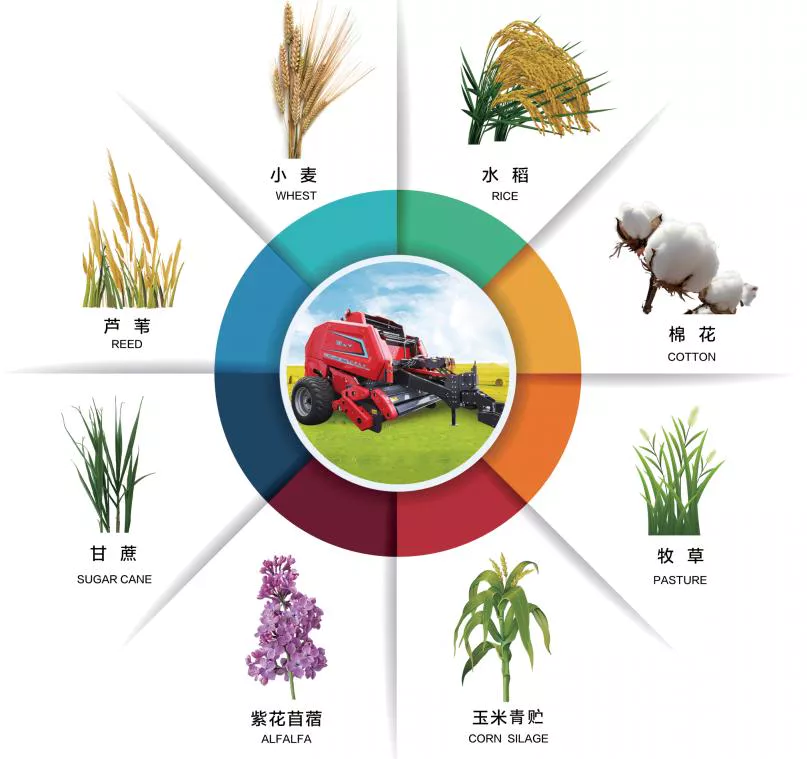
Alt Text: Agricultural round baler collecting crop from a prepared windrow
2. Fixed Chamber vs Variable Chamber Round Balers
Chamber architecture influences how a bale begins forming, how its diameter changes and how density is controlled.
Fixed Chamber
A fixed-chamber baler forms the crop inside a chamber with a predetermined maximum geometry. Depending on the machine, rollers or other rotating components form the bale.
Potential advantages include:
- straightforward bale formation;
- mechanically robust designs;
- repeatable finished bale size;
- suitability for operations that consistently want one bale format.
Variable Chamber
A variable-chamber baler generally uses a system that allows the chamber to expand as crop enters. This enables the operator or control system to produce different bale diameters within the machine’s design limits.
Potential advantages include:
- adjustable bale size;
- more flexibility between customers or crops;
- useful configuration options for contractors.
Modern commercial machines demonstrate how far variable-chamber technology has developed. John Deere currently offers variable-chamber balers and wrapping balers with moisture monitoring and automation functions, while AGCO/Massey Ferguson also markets variable-chamber round balers in multiple maximum bale-size configurations.
Neither architecture is automatically “better.”
A livestock farm producing one standardized dry-hay bale may value mechanical simplicity. A custom-baling contractor working for customers with different bale-size requirements may value adjustability more heavily.
Alt Text: Agricultural round baler engineering design and bale chamber structure
3. Match the Agricultural Round Baler to Your Tractor
A baler and tractor should be evaluated as one operating system.
The tractor has to satisfy the baler’s actual requirements for power, PTO operation, hydraulics, electrical controls, drawbar compatibility and safe handling.
UGA specifically recommends considering horsepower requirements when pairing a baler and tractor. Penn State additionally stresses using an appropriately sized ROPS-equipped tractor and a seat belt when making and handling large bales.
Check These Before Buying
- Minimum tractor horsepower
- Recommended working horsepower
- PTO speed and shaft requirements
- Hydraulic remote requirements
- Electrical/control connections
- Drawbar and hitch specification
- Tractor weight and stability
- Terrain on which the combination will operate
Do not select a baler based only on the tractor’s advertised engine horsepower. The baler manufacturer’s compatibility requirements should control the final decision.
Consider two current examples from the site’s own product range:
| Model | Primary Application | Listed Tractor Requirement | Pickup / Capacity Detail |
|---|---|---|---|
| 9YG-1.25A | Dry hay, alfalfa, legumes | 100–130 HP | Up to 40–100 bales/hour |
| 9YG-2.24D S9000 Classic | Hay, straw, biomass | 75–135 HP | 2.24 m pickup; 40–100 bales/hour |
| 9YH-1.25B | Silage, corn stalks, tough residue | 110–150 HP | 2.2 m pickup; 1.25 × 1.25 m bale |
These figures are model-specific values published on Agricultural-Baler.com and should not be generalized to other machines.
4. Choose Pickup Width and Feeding System
Pickup width determines how comfortably the baler can collect the windrow, but “wider” does not automatically mean “better.”
A wide pickup can be valuable when:
- windrows are broad;
- raking is inconsistent;
- field capacity is a priority;
- operators need more lateral tolerance when following windrows.
A narrower, compact machine may be easier to maneuver when:
- fields are small;
- access roads are narrow;
- terrain is terraced;
- turning space is limited;
- field boundaries are irregular.
The feeding system matters just as much.
Ask the supplier how the machine behaves when material becomes:
- heavy;
- wet;
- tangled;
- uneven;
- fibrous.
If corn stalks are a major crop, for example, the appropriate solution may differ substantially from a gentle spring-tooth pickup intended primarily for leafy dry forage.
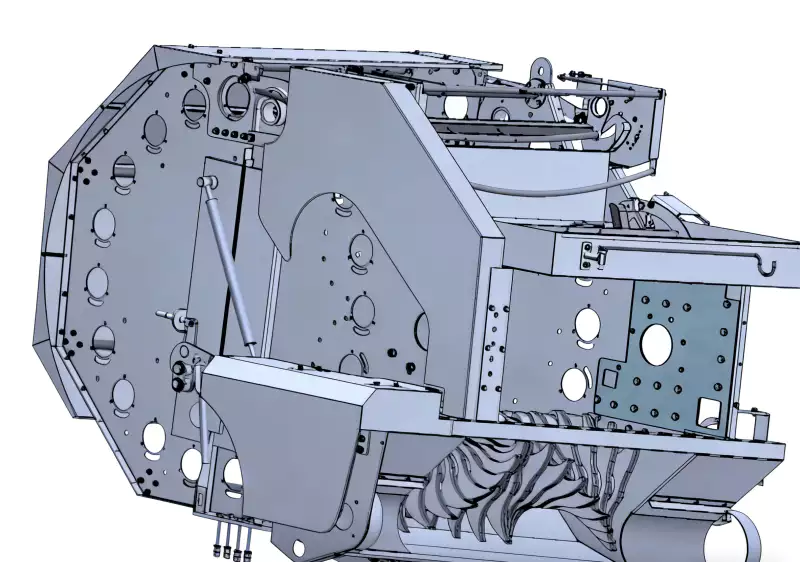
Alt Text: Round baler pickup and feeding system design for agricultural crops
5. Select Bale Size and Density for the Whole Logistics Chain
Bale dimensions affect more than the baler.
They affect:
- finished bale weight;
- loader requirements;
- trailers;
- barn space;
- outdoor storage;
- feeding equipment;
- transportation efficiency;
- customer preferences.
Penn State notes that round bale weights can vary substantially depending on bale dimensions and how tightly the material is packed.
That means buying decisions should start at the end of the process.
If bales will be sold, what size do customers want?
If they will be fed on your farm, what size can your loader safely handle?
If they will be transported long distances, how will the bale dimensions interact with trailer space and legal transport limits in your market?
Density Matters Too
Higher density can reduce the number of bales required for the same amount of harvested dry matter, but density must remain appropriate for the crop and storage method.
For baleage, good density is particularly important because preservation depends on limiting oxygen once the material is wrapped. Penn State identifies bale density as one of the factors influencing how baleage performs after exposure to air.
Do not compare two balers using bale diameter alone. Ask how the machine controls shape, density and consistency.
6. Net Wrap, Twine, or Film?
Wrapping is not an accessory decision to leave until the end.
UGA identifies wrap selection as an important component of successful harvested-feed storage.
Net Wrap
Net wrap is widely used on dry round bales because it can secure the circumference rapidly and produce a tidy finished bale.
Evaluate:
- wrap coverage;
- roll loading;
- cutting reliability;
- number of wrap layers;
- availability and cost of compatible net;
- ease of removing wrap before feeding.
Twine
Twine remains relevant where operating simplicity or material availability makes it appropriate. However, wrapping time and the resulting protection pattern differ from net.
Film / Baleage Wrapping
High-moisture forage requires a preservation strategy designed for baleage rather than merely securing the bale mechanically.
Current wrapping balers illustrate this distinction: John Deere’s C-series variable-chamber wrapping machines are designed for wet and dry crop operation and list poly film or net wrapping options.
The key purchasing question is therefore:
Are you securing a dry bale, or creating an oxygen-limited preservation system for wet forage?
Those are different jobs.
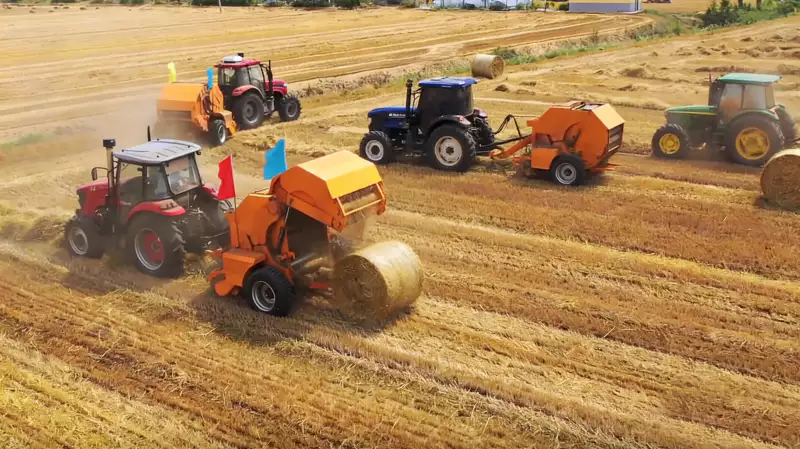
Alt Text: Agricultural round baler producing forage bales during field operation
7. Automation and Sensors: What Matters in 2026?
Premium round balers increasingly use sensors and automation to reduce repetitive operator actions and improve bale consistency.
Current examples include:
- moisture sensing;
- bale-shape sensing;
- bale weighing;
- automatic gate cycles;
- automatic tractor speed adjustments;
- automatic steering/weaving assistance;
- production documentation.
John Deere’s current variable-chamber machines advertise moisture sensing and gate, speed or weave automation, depending on model and configuration. The company also introduced additional round-baling automation for model-year 2026 machines, including automated control intended to improve bale formation and reduce operator workload.
AGCO/Fendt has likewise developed functions including bale weighing and automated lubrication on certain round balers.
But technology should solve a real operating problem.
A contractor making hundreds of bales across multiple customers may gain substantial value from documentation and repeatability. A smaller operation may obtain better return from a mechanically simpler machine with strong parts support.
Use This Rule
Buy automation when its value exceeds its complexity.
Evaluate:
- operator skill;
- annual bale count;
- labor availability;
- downtime cost;
- diagnostic support;
- electronics service availability;
- data actually needed by the farm.
8. Compare Field Conditions, Maintenance and Parts Support
A specification sheet cannot describe your entire farm.
Before ordering, consider:
Terrain
For hills, terraces and fragmented plots, machine width, tractor stability, drawbar behavior and turning space may matter more than theoretical maximum throughput.
Windrow Conditions
Ask how the baler behaves when windrows are narrow, heavy or inconsistent.
Dust and Abrasion
Dry crop residue can create demanding conditions for chains, bearings, pickup teeth and rotating components.
Maintenance Access
Inspect how easily an operator can reach:
- bearings;
- chains or gears;
- lubrication points;
- pickup teeth;
- wrapping components;
- sensors;
- hydraulic connections;
- wear surfaces.
UGA’s pre-season hay-equipment guidance specifically highlights round-baler chamber bearings as components requiring attention before harvest.
Spare Parts
A cheaper baler can become expensive if one small wear component stops the machine during a narrow harvest window.
Ask for a recommended spare-parts package before purchase.
For a heavy-duty hay, straw and biomass option, see the 9YG-2.24D S9000 Classic Agricultural Round Baler.
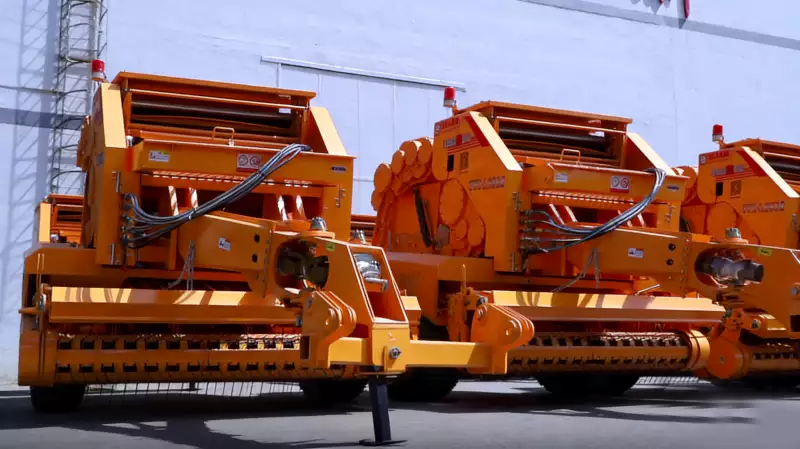
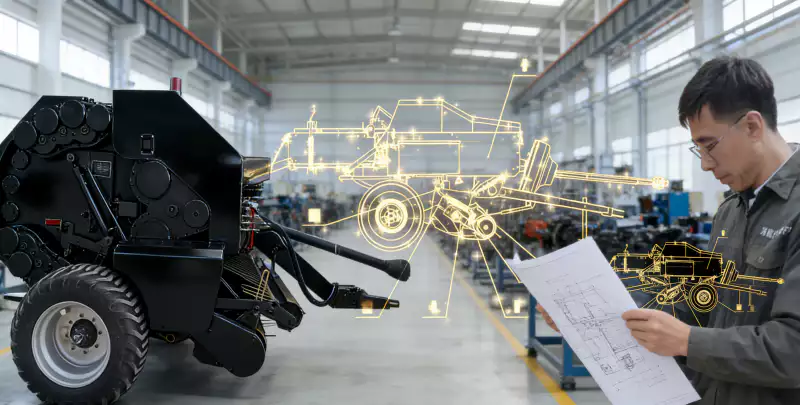
Alt Text: Agricultural round baler manufacturing and factory inspection process
9. Agricultural Round Baler Selection Matrix
Use this framework before requesting quotations.
| Buying Factor | Small Hay Farm | Mixed-Crop Farm | Large Contractor | Silage / Residue Operation |
|---|---|---|---|---|
| Crop flexibility | Medium | High | High | High |
| Adjustable bale size | Optional | Useful | Very useful | Depends on system |
| Wide pickup | Optional | Useful | High priority | High priority |
| Gentle forage handling | High | Medium | Depends on crop | Lower priority |
| Heavy-duty feeding | Medium | High | High | Very high |
| Net wrap | High | High | High | Crop dependent |
| Film capability | Low | If baleage used | Useful | High for baleage |
| Automation | Optional | Useful | High-value | Useful |
| Easy maintenance | High | High | Very high | Very high |
| Parts availability | Critical | Critical | Critical | Critical |
Five-Step Buying Framework
Step 1 — Define the material.
List your top three crops and their expected moisture conditions.
Step 2 — Define the tractor.
Record horsepower, PTO configuration, hydraulics and tractor weight.
Step 3 — Define the bale.
Set preferred diameter, width, approximate weight range and wrapping method.
Step 4 — Define the operating environment.
Document field acreage, slopes, access widths, windrow size and expected annual bale count.
Step 5 — Compare lifetime support.
Evaluate maintenance, spare parts, technical documentation, warranty terms and supplier response—not only purchase price.
10. Five Common Round Baler Buying Mistakes
❌ Mistake #1: Buying by Maximum Throughput
Published bales-per-hour figures depend on crop, moisture, windrow, field shape and operator conditions.
Better approach: Compare realistic productivity in your crop.
❌ Mistake #2: Ignoring Tractor Compatibility
A tractor-baler mismatch can limit performance and create unnecessary operating or safety problems.
Better approach: Confirm the complete tractor interface before purchase.
❌ Mistake #3: Treating All Crops the Same
Dry alfalfa, wheat straw and wet corn residue are different materials.
Better approach: Let crop properties determine pickup and feeding design.
❌ Mistake #4: Choosing Bale Size Without Considering Handling
A larger bale is not automatically more economical if existing loaders, feeders or trailers cannot handle it efficiently.
Better approach: Design the baling system backward from storage and handling.
❌ Mistake #5: Comparing Purchase Price Instead of Downtime Risk
A machine that cannot obtain a bearing, pickup component, belt, chain, gear or sensor during harvest may become the most expensive machine on the farm.
💡 Pro Tip: Ask suppliers to quote the baler plus a recommended harvest-season wear-parts kit.
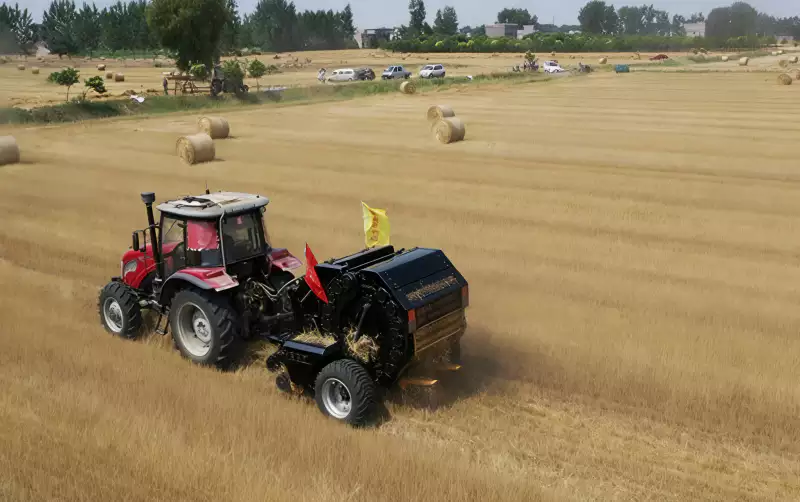
Alt Text: Agricultural round baler working in a commercial farming application
Key Takeaways
✅ Match the baler to the crop first. Dry forage, crop residue and high-moisture forage create different machine requirements.
✅ Treat the tractor and baler as one system. Verify horsepower, PTO, hydraulics, controls and safe operating compatibility.
✅ Choose bale size around logistics. Storage, loading, feeding, transport and customer requirements should influence dimensions.
✅ Evaluate automation by ROI. Moisture sensing, weighing and automatic controls can be valuable, but only when they solve an operating problem.
✅ Parts and service matter as much as specifications. Harvest-season downtime can erase the savings from a cheaper purchase.
Need Help Selecting an Agricultural Round Baler?
Your crop, tractor, field conditions and bale requirements should determine the machine—not the other way around.
Browse our complete Round Baler range, or send us:
- crop type;
- crop moisture condition;
- tractor horsepower;
- field size and terrain;
- target bale size;
- expected annual bale quantity;
- preferred wrapping method.
We can use those details to narrow the available configurations before you request a final quotation.
CTA: Request a Round Baler Recommendation
Author
[AUTHOR NAME] — [VERIFIED JOB TITLE]
[Add a verified 50–80 word author biography covering real agricultural machinery experience, relevant engineering or field expertise, and any certifications that can be documented. Do not publish invented credentials.]
Frequently Asked Questions
What size tractor do I need for an agricultural round baler?
There is no universal horsepower requirement. Tractor demand changes with bale size, feeding system, chamber design, crop density and machine configuration. Check the manufacturer’s minimum and recommended requirements for the exact baler model, then confirm PTO, hydraulic and stability requirements as well.
Is a fixed or variable chamber round baler better?
Neither is automatically better. A fixed-chamber machine can be attractive when consistent bale dimensions and mechanical simplicity are priorities. A variable-chamber machine is useful when operators need adjustable bale diameters or more flexibility across customers and applications.
What is the best round baler for alfalfa?
Look for a machine designed to handle leafy forage smoothly, with an appropriate pickup, controlled feeding, consistent density and an efficient wrapping system. Excessively aggressive crop handling can be undesirable when leaf retention is important. The exact choice should also match your tractor and field conditions.
Can the same round baler handle hay, straw and silage?
Some machines are designed for broad crop flexibility, but this should never be assumed. Wet forage and tough crop residue can require different feeding, cleaning, chamber and wrapping characteristics from dry hay. Verify the manufacturer’s approved crops and operating conditions for the exact model.
Is net wrap better than twine on a round baler?
Net wrap can reduce the time needed to secure a bale and provides broad surface coverage, while twine may remain appropriate for some operations. The better choice depends on wrapping cost, storage method, available supplies, handling practice and the baler’s wrapping system.
Are moisture sensors worth buying on a round baler?
They can be valuable where operators need real-time moisture information, particularly when harvest timing and forage preservation are critical. Current premium machines increasingly integrate moisture sensing with other baling data and automation.
Authoritative References
- University of Georgia Extension — Selecting a Round Baler
- Penn State Extension — Baleage
- Penn State Extension — Safely Making and Handling Large Hay Bales
- John Deere — Current Round Baler Technology
FAQPage Schema
<script type="application/ld+json">
{
  "@context": "https://schema.org",
  "@type": "FAQPage",
  "mainEntity": [
    {
      "@type": "Question",
      "name": "What size tractor do I need for an agricultural round baler?",
      "acceptedAnswer": {
        "@type": "Answer",
        "text": "There is no universal horsepower requirement. Match the tractor to the exact baler model and verify horsepower, PTO, hydraulic, electrical and stability requirements."
      }
    },
    {
      "@type": "Question",
      "name": "Is a fixed or variable chamber round baler better?",
      "acceptedAnswer": {
        "@type": "Answer",
        "text": "Neither is automatically better. Fixed chambers can suit operations wanting consistent bale dimensions, while variable chambers provide greater flexibility in bale diameter."
      }
    },
    {
      "@type": "Question",
      "name": "What is the best round baler for alfalfa?",
      "acceptedAnswer": {
        "@type": "Answer",
        "text": "Choose a baler designed for smooth handling of leafy forage with an appropriate pickup, controlled feeding, consistent density and efficient wrapping, while matching tractor and field requirements."
      }
    },
    {
      "@type": "Question",
      "name": "Can the same round baler handle hay, straw and silage?",
      "acceptedAnswer": {
        "@type": "Answer",
        "text": "Some models can handle multiple crops, but crop compatibility must be confirmed for the exact baler because wet forage, dry hay and tough residue create different feeding and wrapping requirements."
      }
    },
    {
      "@type": "Question",
      "name": "Are moisture sensors worth buying on a round baler?",
      "acceptedAnswer": {
        "@type": "Answer",
        "text": "Moisture sensors can add value when operators need real-time forage moisture information for harvest timing, quality control and preservation decisions."
      }
    }
  ]
}
</script>