Beschrijving
9F-70 Industrial Diesel-Driven Forage Crusher
Heavy-Duty 191 kW Hammer Mill System Engineered for Massive 20 Tons/Hour Biomass Pulverization and Commercial Feed Preparation
⚙️ 191 kW Diesel Engine Driven
🔨 64 High-Velocity Hammers
🏗️ 5500 kg Welded Chassis
1. Comprehensive Product Overview: Mega-Scale Biomass Processing
De 9F-70 Forage Crusher is the absolute apex of commercial agricultural grinding technology, engineered specifically for operations demanding unrelenting high-volume throughput. As the global demand for finely processed biomass, commercial animal feed, and biofuel substrates escalates, the reliance on underpowered, grid-dependent electric grinders becomes a severe operational liability. The 9F-70 shatters these limitations by integrating a colossal 191 kW (approx. 256 HP) industrial diesel engine directly into its heavy-duty welded framework. This autonomous, fixed-power design transforms the Feed Crusher into an off-grid powerhouse, capable of being deployed at remote agricultural depots, massive livestock feedlots, or deep-field staging areas without the requirement of a 3-phase industrial electrical grid.
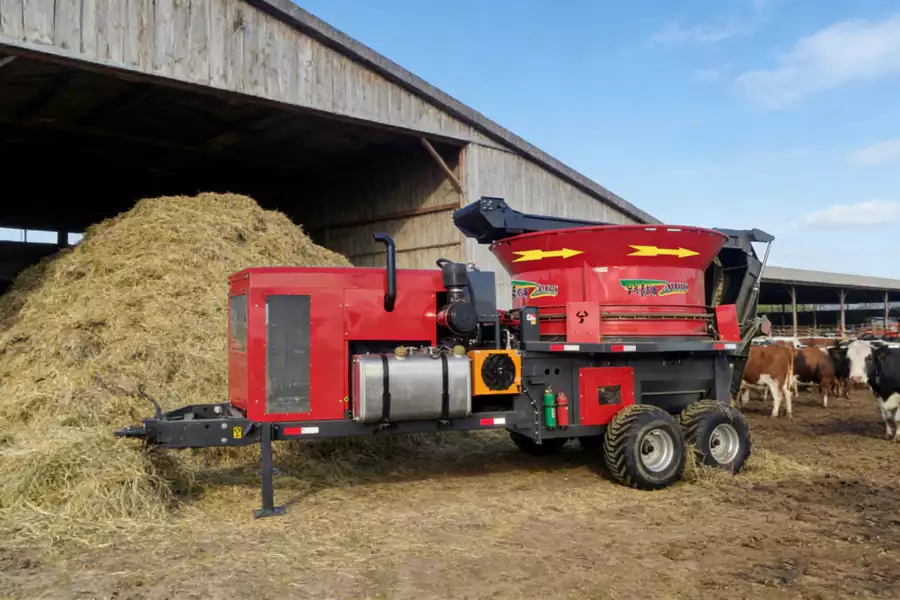
Operating as a stationary processing plant, this advanced Hammer Mill utilizes an internal rotor boasting a 700 mm working diameter armed with 64 forged, high-carbon steel hammers. Spinning at a ferocious 1800 r/min, it instantly pulverizes agricultural roughage, including dry hay, alfalfa, corn stalks, wheat straw, and dense biomass briquettes. To eliminate the feeding bottlenecks that plague inferior models, the 9F-70 features a highly advanced cylindrical feeding system, measuring 1100 mm in width. This ensures a consistent, high-volume flow of material into the crushing chamber, yielding a staggering productivity rate of 5 to 20 tons per hour depending on the target micron size and material moisture content. Whether you are producing fine ruminant feed or preparing material for a high-density baling operation, the 9F-70 delivers unparalleled consistency and raw power.
Core Technology Quick Read
To maximize commercial processing margins and ensure absolute mechanical dominance, procurement directors must evaluate the specialized kinetic parameters of the 9F-70 prior to deployment.
This Biomass Crusher operates entirely independently of external power grids or tractor PTOs. The integrated 191 kW diesel power plant provides massive, uninterrupted torque directly to the main rotor shaft, preventing stalling when fed highly dense or damp crop residues.
The 700mm diameter working rotor spins at 1800 rpm, generating extreme centrifugal kinetic energy. The 64 heat-treated steel hammers impact the incoming material thousands of times per second, ensuring uniform pulverization and maximum processing throughput up to 20 tons per hour.
Traditional gravity-fed hoppers bridge and clog. The 9F-70 utilizes an active cylindrical feeding system that aggressively grabs and forces the roughage into the 1100mm wide crushing chamber, ensuring the massive 256 HP engine is continuously supplied with material.
2. Rigorous Engineering Specifications & Technical Data
The following data matrix explicitly details the structural, kinetic, and dimensional parameters of the 9F-70 model. All specifications are meticulously validated through comprehensive industrial trials to guarantee absolute B2B procurement integrity.
| Nee. | Parameter Category / Item | Eenheid | Standard Specification Data |
|---|---|---|---|
| 1 | Official Product Name | / | 9F-70 Forage Crusher |
| 2 | Operation Structure | / | Stationary Operation (固定作业) |
| 3 | Drive Method | / | Fixed Power (固定动力) |
| 4 | Power Source Type | / | Diesel Engine (柴油发动机) |
| 5 | Engine Rated Power | kW | 191 (Approx. 256 HP) |
| 6 | Casing Manufacturing Method | / | Heavy-Duty Welded Frame |
| 7 | Rotor Structure Type | / | Hammer Mill Type (锤片式) |
| 8 / 11 | Total Number of Hammers | stuks | 64 |
| 9 | Rotor Disc Diameter | mm | 450 |
| 10 | Rotor Working Diameter | mm | 700 |
| 12 | Crushing Chamber Width | mm | 1100 |
| 13 | Overall Dimensions (L x W x H) | mm | 7700 x 2600 x 2900 |
| 14 | Power Output Shaft Speed | toerental | 1800 |
| 15 | Equipment Wheel Track | mm | 2200 |
| 16 | Productivity Rate | Tons/h | 5 – 20 |
| 17 | Total Structural Mass Weight | kg | 5500 |
| 18 | Feeding Intake Method | / | Cylindrical Active Feeding System |
🔥 Autonomous 191 kW Diesel Power Plant
The cornerstone of the 9F-70’s industrial superiority is its total grid independence. By mounting a dedicated 191 kW (256 Horsepower) industrial diesel engine directly onto the 5500 kg chassis, this Agricultural Grinder eliminates the massive voltage drops and tripped breakers associated with high-capacity electric mills. The direct-drive configuration translates immense diesel torque straight to the 1800 r/min main shaft. This allows the machine to chew through wet, fibrous, or heavily baled crop residues without bogging down. Furthermore, the 2200 mm wheel track allows the entire unit to be towed (at low speeds) by a tractor from one remote staging area to another, bringing the processing plant directly to the harvest rather than hauling raw biomass to a central electrical facility.
4. Distinctive Engineering Features & Commercial Advantages
The 9F-70 is not merely a grinder; it is a meticulously calibrated volume-reduction system designed for industrial agribusiness. Explore the engineering superiorities that protect your commercial feed supply.
20 Tons/Hour Extreme Throughput
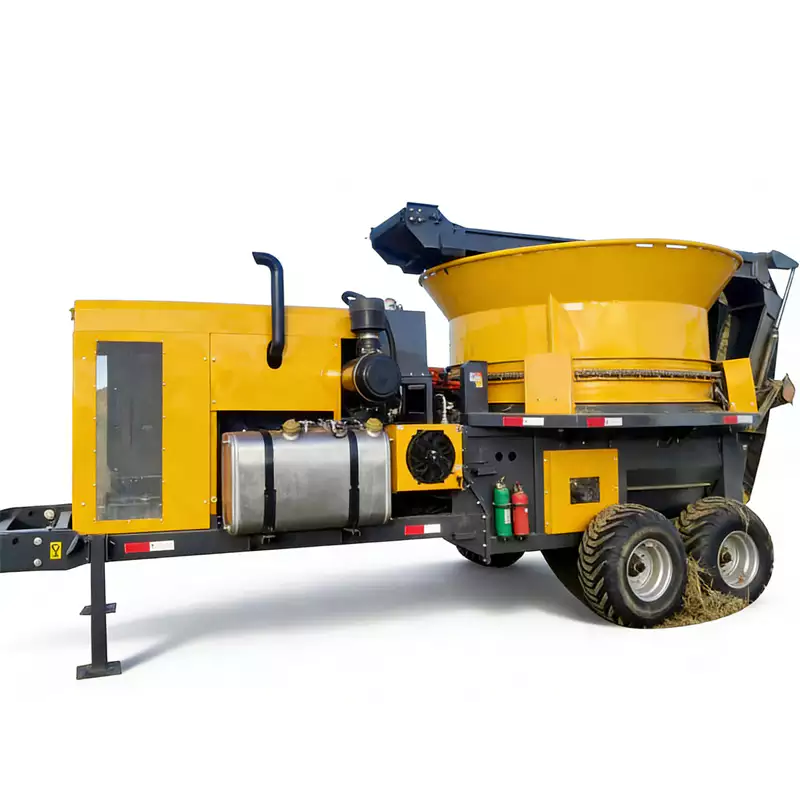
Built upon an ultra-rigid, welded 5.5-ton carbon steel chassis, the 9F-70 is engineered to endure immense internal kinetic stress. With a maximum rated throughput of up to 20 metric tons per hour, it effortlessly reduces massive stacks of round bales or bulk biomass into fine feed. This massive capacity slashes processing times, keeping large feedlots fully supplied and maximizing operator labor efficiency.
64-Hammer Pulverization Matrix
The heart of this Forage Crusher is the 700mm diameter working rotor armed with 64 reversible, heat-treated steel hammers. Spinning at 1800 rpm, these hammers create a devastating kinetic storm inside the 1100mm wide chamber. They shatter tough lignin fibers in stalks and stems, increasing the surface area of the feed to radically improve digestive absorption and feed conversion ratios in cattle.
Active Cylindrical Intake
Inferior gravity-fed crushers frequently bridge and clog, requiring dangerous manual unclogging. The 9F-70 utilizes an active cylindrical feeding system that physically grips the incoming hay or stalks and forces them evenly into the hammer mill chamber. This ensures a consistent, uninterrupted load on the diesel engine, maximizing fuel efficiency and preventing costly stalls.
Heavy-Duty Welded Casing
When 64 steel hammers spin at 1800 rpm, the internal forces and vibrations are immense. The entire external casing of the 9F-70 is constructed from thick-plate, fully welded carbon steel. This industrial build quality absorbs harmonic vibrations, prevents catastrophic casing blowouts from foreign objects (like hidden field rocks), and ensures decades of safe commercial operation.
5. Deep Engineering Dive: Thermodynamics & Pulverization Mechanics
The architectural philosophy governing the 9F-70 Feed Crusher centers on the relentless application of blunt-force kinetic energy. The machine is dominated by its 7700 x 2600 x 2900 mm footprint. Material fed into the active cylindrical intake is pushed violently into the path of the 700mm diameter rotor. Here, the 64 rectangular steel hammers do not “cut” the material; they shatter it. As the material is struck, it is driven against heavily ribbed internal wear plates lining the 1100mm wide crushing chamber.
This continuous shattering process continues until the organic particles are small enough to be evacuated through the heavy-duty steel sizing screens located at the bottom of the chamber. Because this immense friction generates significant thermodynamic heat and air pressure, the welded casing is engineered with specific volumetric relief zones, allowing the 191 kW diesel engine to push material through the screens via the induced wind draft without causing thermal degradation to the nutritional value of the feed.
The 5500 kg mass of the machine acts as an essential dampening anchor. Supported by a heavy axle with a 2200 mm wheel track, the unit remains completely stable during the violent 1800 r/min operational cycles, ensuring the main rotor bearings are not subjected to destructive lateral vibrations, thereby extending the maintenance intervals significantly.
6. Specialized Industrial Application Scenarios
Volume reduction and feed preparation dictate agricultural profitability. The 9F-70 proves its absolute dominance across a variety of demanding, high-volume commercial environments globally.
🐄 Mega-Feedlot TMR Preparation
For feedlots housing tens of thousands of cattle, roughage like corn stalks and tough prairie grass must be pulverized rapidly before being added to the Total Mixed Ration (TMR) mixer. The 9F-70 churns out up to 20 tons of finely ground material per hour, ensuring cattle cannot selectively sort their feed, maximizing intake and weight gain.
⚡ Biomass Pellet & Briquette Production
Woody biomass and agricultural straw must be reduced to a uniform dust before it can be extruded into biofuel pellets. The autonomous 191 kW diesel engine allows this Biomass Crusher to be placed directly at forestry or farm edges, pulverizing raw material on-site to drastically reduce transport volumes to the pelletizing plant.
🌾 High-Volume Alfalfa Meal Processing
High-protein alfalfa must be milled into fine meal for inclusion in premium poultry and swine diets. The intense 1800 rpm strike rate of the 64 hammers pulverizes dry alfalfa instantly, generating a massive airflow that pushes the powder through the sizing screens quickly, preventing heat build-up that destroys the crude protein.
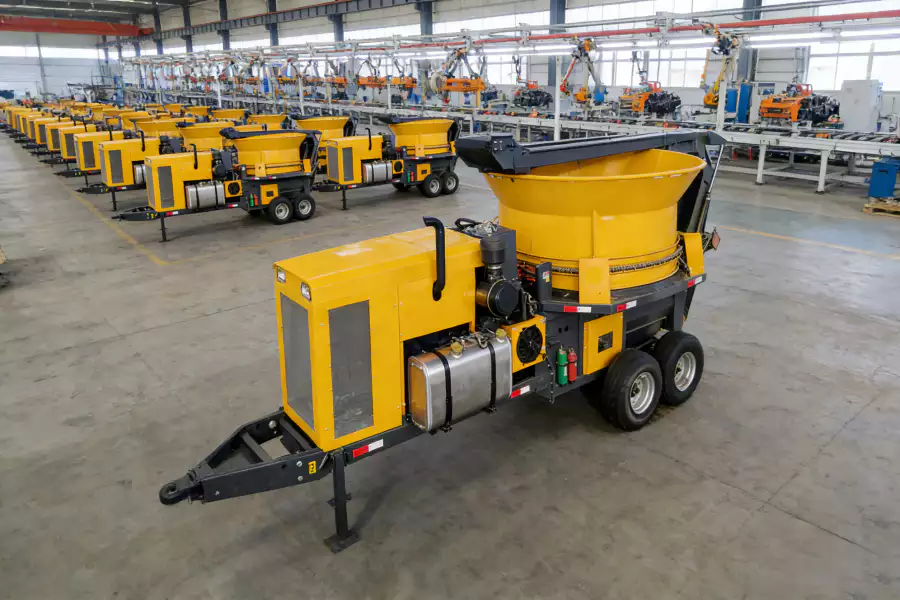
7. Competitive Advantage Matrix: Diesel 9F-70 vs. Grid-Tied Electric Mills
| Logistical Metric | Our 9F-70 Diesel Hammer Mill | Traditional Industrial Electric Crushers |
|---|---|---|
| Location Flexibility | Total Freedom. 191 kW Diesel engine allows setup anywhere. | Severely Limited. Demands proximity to heavy 3-phase industrial power grids. |
| Torque Response | Exceptional. Diesel engines provide massive, unyielding mechanical torque to power through dense, wet clogs. | Poor. Electric motors frequently trip breakers or burn out stators under heavy, sudden loads. |
| Feeding Consistency | Active Cylindrical Feeder forces 1100mm wide material into the chamber evenly. | Gravity-fed hoppers constantly bridge, requiring manual intervention to unjam. |
| Transport Logistics | Grind the bulk material off-grid, drastically reducing the volume required for truck transport. | Forces farms to transport massive volumes of un-crushed air (fluffy hay) to the grid-tied factory. |
8. Kinematic Working Principle & Industrial Operation Flow
Autonomous Power Engagement
The operator starts the onboard 191 kW diesel engine. A heavy-duty industrial clutch is engaged, smoothly transferring immense torque to the main rotor shaft, accelerating the 64 hammers up to the operational speed of 1800 rpm.
Active Cylindrical Intake Feeding
Bulk material (hay, stalks, straw) is loaded via a telehandler or conveyor. The active cylindrical feeding system violently grips the material and forces it evenly across the 1100mm width into the crushing chamber, preventing jams.
High-Velocity Hammer Pulverization
Inside the chamber, the 64 hardened steel hammers strike the incoming material at extreme velocity, driving it against the heavy ribbed wear plates. The material is instantly shattered, pulverized, and reduced to fine particles.
Screen Sizing & Wind-Draft Evacuation
The shattered particles are aggressively forced through heavy-duty sizing screens at the base of the unit. The immense air draft generated by the 1800 rpm rotor blows the finished, uniform feed material out for immediate bagging or silo storage.
10. Global Engineering Field Notes & Verified Case Studies
Industrial feed processing is punished relentlessly by material density and scale. Review these verified field notes from global plant managers deploying the massive 9F-70.
[Texas, USA] Mega-Scale Feedlot Feed Crusher Integration
Client Profile: 50,000 Head Beef Feedlot. Core Objective: Eliminating electrical grid bottlenecks while processing 300 tons of roughage daily.
“We were blowing massive commercial breakers trying to run three electric hammer mills simultaneously to keep up with our feed demand. We completely decentralized our roughage processing by parking the 9F-70 out by the silage bunkers. The 191 kW diesel engine never bogs down, even when we feed it dense, frozen bales. We push 18 tons an hour easily, saving a fortune in industrial electrical demand charges.”
[Queensland, Australia] Off-Grid Outback Biomass Crusher Deployment
Client Profile: Remote Agricultural Biofuel Co-op. Core Objective: Processing tough sugarcane and sorghum residues 300 miles from 3-phase power.
“Out here, electricity is a luxury. We needed a machine that brought the factory to the field. The 5.5-ton chassis on this Forage Crusher is welded like a tank. We tow it between stations on its 2200mm axle, fire up the diesel, and the 64 hammers pulverize the toughest sugarcane stalks into perfect biofuel substrate powder. It’s an unstoppable, self-reliant beast.”
[Mato Grosso, Brazil] High-Humidity Tropical Forage Processing
Client Profile: Massive Soy & Corn Operation. Core Objective: Preventing intake bridging and clogging with wet, sticky tropical crop residues.
“Tropical humidity makes stalks wet, heavy, and sticky. Standard gravity-fed grinders simply plug up, and a worker has to risk their life clearing the jam. The 9F-70’s cylindrical active feeding system physically grabs the wet stalks and shoves them into the 1100mm wide chamber. The 1800 rpm draft blows the wet particles right through the screens. It’s a lifesaver.”
[Alberta, Canada] Freezing Condition High-Volume Grinding
Client Profile: Commercial Swine & Dairy Feed Mill. Core Objective: Maintaining 20 Ton/Hour output while shattering solid frozen hay bales in -20°C weather.
“Frozen hay bales are practically blocks of ice. You need raw, brutal torque to break them down. The 256 HP diesel engine doesn’t flinch. The 700mm working diameter of the rotor creates a massive strike zone. We run it 10 hours a day in freezing conditions, and the heavy-duty welded casing handles the extreme internal impacts flawlessly.”
11. B2B Client Frequently Asked Questions (FAQ)
Q1: How is a 5500 kg, 7.7-meter-long machine shipped internationally?
To optimize B2B ocean freight logistics, the 9F-70 is shipped with specific components (like the cylindrical intake hopper and exhaust chutes) in a Semi-Knocked Down (SKD) configuration. It is securely strapped to heavy-duty flat racks or inside 40ft High-Cube shipping containers depending on the bulk order size.
Q2: What types of materials can the 64-hammer rotor process?
The 9F-70 Agricultural Grinder is highly versatile. It dominates dry hay, alfalfa, wheat straw, corn stalks, and sorghum. It is also routinely used for heavy biomass processing, including wood chips, bark, and dried organic municipal waste destined for pelletizing or composting.
Q3: Can we adjust the final output size of the crushed material?
Yes. The final particle size is dictated entirely by the heavy-duty steel sizing screens located at the bottom of the crushing chamber. We provide a variety of screen mesh sizes. Swapping screens takes only a few minutes, allowing you to switch from producing coarse cattle roughage to fine poultry meal instantly.
Q4: Does the diesel engine require specialized maintenance?
The 191 kW power plant is a standard, industrial-grade commercial diesel engine. It requires only standard heavy-equipment maintenance protocols: regular oil changes, strict air filter blow-outs (due to the dusty crushing environment), and fuel filter replacements. Any qualified diesel mechanic can service it.
Q5: Are the 64 hammers reversible?
Yes. To maximize your operational ROI and minimize consumable costs, the high-carbon steel hammers are engineered with a rectangular profile. Once the leading impact edge becomes dull, the operator can unpin the hammers, flip them 180 degrees, and utilize a fresh, sharp corner, effectively doubling the lifespan of the hammer set.
Q6: How do you move the machine if it is stationary?
While it is designated for “Stationary Operation” while crushing, the 5500 kg chassis sits on a heavy-duty axle with a 2200 mm wheel track and a front drawbar. This allows it to be towed slowly by a standard farm tractor from the storage depot out to the field staging area.
Q7: Do you supply spare OEM parts like sizing screens and hammers globally?
Yes. As a premier primary agricultural manufacturer, we hold deep, year-round inventories of all OEM consumable components. Whether you need replacement hammer sets, sizing screens, main rotor bearings, or agricultural gearboxes (for your other machinery), we dispatch globally via express air freight.
12. Critical Operational Calibration & Engineering Precautions
To prevent catastrophic equipment damage and ensure a 20 Ton/Hour throughput, operators must strictly adhere to these safety and maintenance protocols:
- Rotor Balance Integrity: If a hammer breaks due to foreign object ingestion (e.g., a steel fence post), the machine MUST be shut down immediately. Replacing only one hammer destroys the rotational balance of the 1800 rpm rotor. You must replace the broken hammer AND the corresponding hammer on the exact opposite side of the disc to prevent catastrophic bearing failure.
- Engine Air Filtration: Biomass crushing generates massive, highly abrasive dust clouds. The diesel engine’s dual-stage air intake filters must be blown out with compressed air daily (or twice daily in extremely dry conditions) to prevent engine scoring and piston failure.
- Tramp Metal Avoidance: While the machine is rugged, it is designed for organic matter. The active intake should ideally be fed via a system equipped with high-power industrial magnets to catch loose baling wire, wrench heads, or tramp metal before it enters the 64-hammer crushing chamber.
13. Macro-Economic Trends & Strategic ROI Analysis
The trajectory of global commercial agriculture is sharply focused on decentralization and massive volume reduction. Transporting light, fluffy, raw crop residue requires massive trucking fleets, effectively paying to “transport air.” The modern agronomic imperative is to process and densify biomass directly at the source. The 9F-70 Feed Crusher is the physical manifestation of this economic trend. By providing its own 191 kW power source, it allows commercial operations to set up mega-scale grinding depots anywhere on the map, drastically reducing raw logistics costs.
Return on Investment (ROI) Economics: The mathematics driving the adoption of the 9F-70 are undeniable. Operating an electric grinder of this scale requires pulling $50,000+ worth of high-voltage 3-phase lines to a remote site, plus paying punitive peak-demand electrical charges. The diesel-driven 9F-70 bypasses these grid costs entirely. Furthermore, by processing up to 20 tons per hour, it slashes hourly labor overhead. For a commercial feed mill or biomass exporter, the ability to rapidly convert low-value raw stalks into high-value, finely milled substrate pays for the entire capital cost of the 9F-70 within a matter of months.
14. Complete Your Advanced Mechanized Fleet
As an elite global OEM manufacturer of heavy agricultural machinery, we engineer holistic solutions. Feed the massive appetite of the 9F-70 by efficiently aggregating and baling your crop with our high-performance field equipment:
🌾 Commercial Bale Wrapping Machines
⚙️ Specialized Kidney Bean Pullers
🌱 High-Speed Rotary Rakes
*We also supply premium OEM agricultural parts globally, including PTO shafts, agricultural gearboxes, forged gears, pulleys, sprockets, and high-tensile chains.
Ready to Maximize Your Processing Throughput?
Stop relying on underpowered grid-tied grinders. Contact our specialized engineering sales team today to discuss bulk B2B shipping logistics, container loading, and off-grid integration for the massive 9F-70 Industrial Forage Crusher.